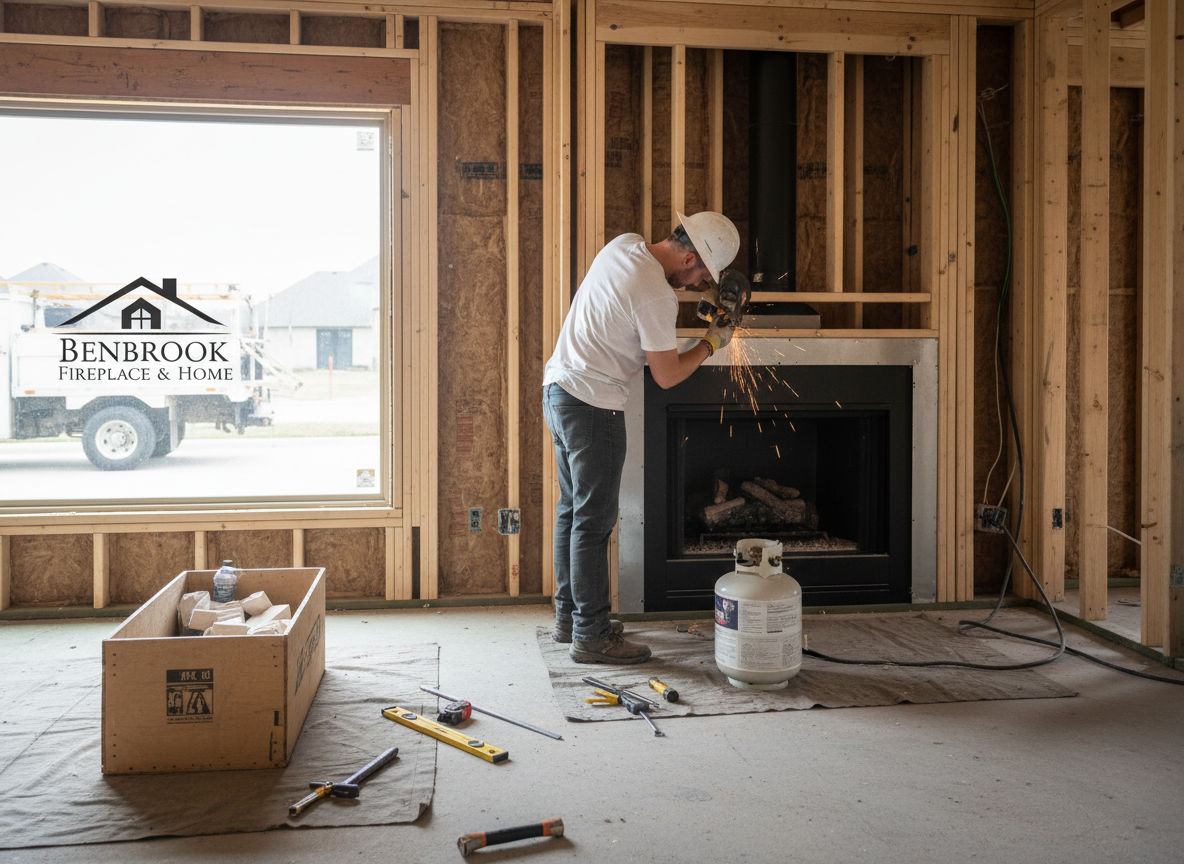
Benbrook homes built from the 1960s through the 1980s often feature masonry fireplaces set on slab foundations that sit on expansive clay soils near Benbrook Lake and the Clear Fork of the Trinity River. These soils expand and contract with seasonal moisture swings, creating hairline cracks at the firebox-to-chimney joint that only become visible after the first hard freeze. Proper installation requires a reinforced concrete pad extension and flexible flashing that accommodates up to three-quarters of an inch of movement without tearing.
Winters here bring sudden temperature drops below freezing followed by rapid thaws, so we size the flue liner to maintain draft even when outdoor air is 30 degrees colder than indoor air. We also account for the high summer humidity that drives condensation inside unused flues; a stainless-steel liner with a rain cap and a tight-fitting damper seal prevents moisture from rusting the smoke chamber over the long summer months.
Tarrant County permitting requires a minimum 2-inch clearance to combustibles on new inserts and a 36-inch hearth extension for wood-burning units. We pull permits, schedule the inspection, and leave the homeowner with the stamped paperwork. In neighborhoods like River Hills and Benbrook Hills, narrow side yards and mature oak trees often force us to use sectional scaffolding rather than a boom truck, adding time but protecting both the home and the surrounding landscape.
Technician insight
In Benbrook, the thing that catches most people out with fireplace installation is the way clay soils around the lake shift older slab foundations every few years. Homeowners in River Hills and Benbrook Hills assume a straight swap will work, but without a reinforced pad and flexible flashing the new unit ends up with cracked mortar at the smoke chamber within two winters.
Shifting Slab in a 1978 Benbrook Home
The homeowner called after noticing smoke backing into the living room during the first cold snap. We found the original slab had settled two inches on the lake side of the lot, pulling the firebox away from the chimney. We installed a new reinforced pad, added a stainless liner with expansion joints, and tied the flashing to allow movement. The county passed inspection the next day and the fireplace now drafts cleanly even after freeze-thaw cycles.
How it works
- 1
Site Assessment And Soil Check
We inspect the existing chimney base, measure foundation movement around Benbrook Lake clay soils, and verify clearances to nearby framing.
- 2
Design And Permit Submission
We select the correct liner size and insert type for local winter draft conditions, then submit drawings to Tarrant County for approval.
- 3
Foundation Reinforcement
A reinforced pad is poured where needed to counter soil heave common in older Benbrook slabs before any new unit is set.
- 4
Installation And Final Inspection
The unit, liner, and flashing are installed with movement-tolerant details; county inspection follows within 48 hours.
Pricing
Pricing varies by chimney height, soil conditions, and whether reinforcement is required; we provide an upfront written quote after the site visit.